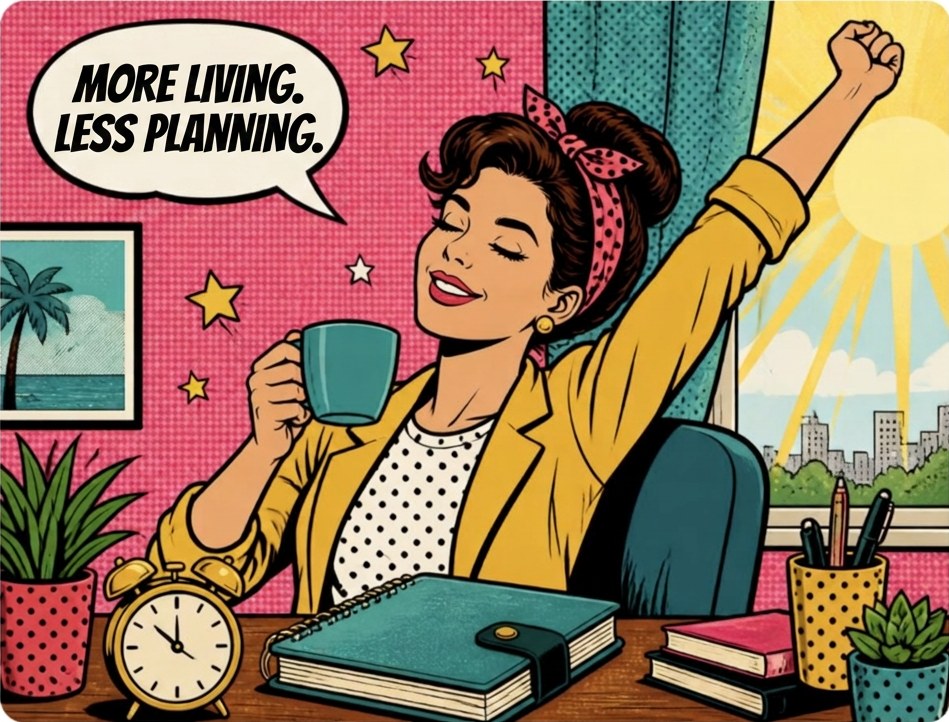
There is something undeniably hopeful about a brand-new planner.
The pages are crisp. The calendar is empty. The possibilities feel endless.
For a moment, it seems as if this beautiful collection of boxes, lists, trackers, and inspirational quotes might hold the secret to becoming the person we have always wanted to be.
This will be the month we remember every appointment.
This will be the year we drink enough water, plan every meal, exercise regularly, answer every email, organize the house, grow the business, nurture our relationships—and somehow still have time for a peaceful evening routine.
We don’t just buy a planner.
We buy the possibility of a better version of ourselves.
Then real life arrives.
An unexpected appointment changes the schedule. We wake up without energy. Someone we love needs us. A project takes longer than expected. The laundry multiplies when no one is looking. We miss a day in the planner, then another—and suddenly, opening it doesn’t feel hopeful anymore.
It feels like evidence.
Evidence that we didn’t follow through.
Evidence that we are falling behind.
Evidence, we may wrongly decide, that we are simply not disciplined enough.
That is the planner shame spiral—and far too many of us know it well.
When a Helpful Tool Starts Feeling Like a Report Card
A planner is supposed to help us remember our lives, not make us feel guilty for living them.
But somewhere along the way, planning became tangled up with our ideas about productivity, success, and self-worth.
A fully completed planner looks impressive. Every box is checked. Every hour has a purpose. Every habit is tracked. Nothing appears to have been forgotten, postponed, or abandoned.
Real life rarely looks that tidy.
Real life has crossed-out appointments, unfinished tasks, sudden changes, difficult mornings, wonderful interruptions, health challenges, family needs, and days when simply getting through the day is the accomplishment.
The problem is not that planners exist. Planners can be incredibly useful.
The problem begins when we start serving the planner instead of allowing the planner to serve us.
We spend so much time creating the perfect plan that we have less time—and sometimes less energy—to live it.
Why We Keep Trying Again
If planners have disappointed us before, why are we still drawn to them?
Because planning offers a feeling of control.
When life feels complicated, writing everything down can create order. It turns a swirl of responsibilities into something visible and, at least temporarily, manageable.
Planning can also provide a fresh start.
A new page whispers, “Yesterday is over. You can begin again.”
That can be genuinely comforting. There is nothing wrong with wanting clarity, structure, or a more peaceful routine.
The difficulty comes when we expect a planning system to change us through sheer force of organization.
We believe that if the layout is detailed enough, we will never procrastinate. If the habit tracker is attractive enough, we will never lose motivation. If we schedule every hour, life will finally cooperate.
But no planner can remove exhaustion, grief, pain, caregiving responsibilities, financial stress, shifting priorities, or the beautiful unpredictability of being human.
A planner cannot make life obey us.
It can only help us meet life with a little more clarity.
The Shame Spiral Is Not a Motivation Strategy
The cycle often begins innocently:
We make an ambitious plan.
We complete part of it.
Something interrupts us.
We fall behind.
We feel guilty.
Then, in an effort to recover, we create an even more detailed plan.
Now we are not only trying to complete today’s responsibilities—we are also carrying yesterday’s unfinished tasks and tomorrow’s expectations.
Eventually, the planner becomes so crowded that we avoid looking at it altogether.
Avoidance leads to more guilt. Guilt convinces us that we need a stricter system. The stricter system becomes impossible to maintain.
And around we go.
The gentlest way out is not to become harder on yourself.
It is to stop treating every unfinished task like a character flaw.
You are not lazy because your plan changed.
You are not irresponsible because your energy changed.
You are not failing because a page contains empty spaces.
An unfinished planner is not a moral judgment. It is simply a tool that no longer matched the day you had.
Let One Page Be Enough
This realization became part of the heart behind Life in One Page by Mandy.
I didn’t want planning to feel like another enormous responsibility. I wanted it to feel like a deep breath.
One page asks you to identify what matters without demanding that you document every second of your life.
It lets you see the important pieces together:
What truly needs your attention
What would be helpful, but can wait
What appointments or deadlines must be remembered
What your body, mind, home, family, or business needs today
Where you can leave room for rest and the unexpected
A one-page plan does not attempt to control everything.
It gives the day a gentle shape.
That difference may sound small, but it changes the entire experience. Instead of spreading your attention across dozens of sections, you can look at one clear page and decide where your energy belongs.
Plan for the Life You Actually Have
Many planning systems are created for our ideal selves.
Our ideal selves wake up early, feel energetic, stay focused, never get sick, never receive an unexpected phone call, and apparently have no one interrupting them.
But your planner should belong to the person you are today.
If you have three usable hours, do not assign yourself eight hours of tasks.
If your body needs rest, include rest in the plan rather than treating it as something that ruined the plan.
If one appointment will require most of your emotional or physical energy, allow that appointment to be enough.
Planning realistically is not giving up.
It is showing yourself the respect of telling the truth.
A plan should reflect your actual capacity—not punish you for failing to have unlimited capacity.
Try the “Three Things” Practice
If your current system feels overwhelming, begin with three simple questions:
1. What must happen today? Choose the responsibilities with genuine consequences or importance.
2. What would make today feel meaningful? This might be working on a goal, spending time with someone you love, preparing a nourishing meal, or creating something beautiful.
3. What can I release without guilt? Give yourself permission to postpone, delegate, simplify, or completely remove something.
That final question is especially important.
We are often skilled at adding tasks but uncomfortable subtracting them. Yet every “yes” takes time from somewhere else. Sometimes the most productive choice is recognizing what does not need to happen today—or at all.
Leave Space for Being Human
White space is not wasted space.
An open hour can become recovery time, a meaningful conversation, a moment of inspiration, or simply protection against the day’s inevitable surprises.
When every minute is already assigned, even a small interruption can make us feel as though the entire day has collapsed.
A little space makes a plan more flexible and our minds more peaceful.
It also creates room for the parts of life we cannot measure:
Laughter.
Prayer.
Connection.
Creativity.
A slow cup of coffee.
A cuddle with our precious pups.
A conversation that lasts longer than expected because someone needed to be heard.
These moments may never appear on a productivity chart, but they are often the moments that make a life feel full.
Productivity Is Not the Same as Worth
You are valuable on the days when you complete everything.
You are equally valuable on the days when you complete almost nothing.
Productivity can help us care for our responsibilities and move toward meaningful goals, but it should never become the ruler we use to measure our worth.
We were not placed on this earth merely to complete tasks.
We are here to love, learn, create, serve, recover, connect, notice, grow, and experience the astonishing privilege of being alive.
A planner can support those things.
It should never replace them.
A Gentler Way Forward
You do not have to throw away every planner, abandon your goals, or stop making lists.
Just make the system smaller than your life.
Let it hold the important details without demanding every detail. Let it guide you without scolding you. Let it change when your circumstances change.
Most importantly, let yourself begin again without creating a punishment plan for everything that did not happen yesterday.
Cross something out.
Move something forward.
Leave a box empty.
Choose three priorities instead of thirty.
Close the planner when it has done its job—and go live the life it was meant to support.
Less planner. More breathing. More flexibility. More grace. More living.
That is not doing less with your life.
It is finally making room to be present for it.
With love,
Mandy
Life in One Page by Mandy
Explore the Life in One Page by Mandy Collection for colorful, practical planning pages designed to bring your responsibilities into focus—without allowing them to take over your life.
Browse the collection